
Endgame Class
A competitive sport tends to have one key element in which a professional is expected to demonstrate his class. Failing in this key discipline is more than poor: it’s almost a moral crime, something to feel ashamed about. In chess, the endgame is that element.
These book reviews by Matthew Sadler were published in New In Chess magazine 2025#6
Towards the end of July, I joined Natasha Regan at the 2025 British Championships in Liverpool to commentate on the blitz and rapid junior championship events (from Under-16 down to Under-8) played just before the main event.
Natasha had the lovely idea of inviting all the parents into the commentary room, and then asking the kids to come to our table after they finished their games to show us their games (if they wanted, of course!) After a few minutes of uncertainty, it really took off and we soon had long queues of proud and enthusiastic kids. As you can tell from the stream (on the ECF YouTube site), it was a pretty chaotic but very fulfilling couple of days!
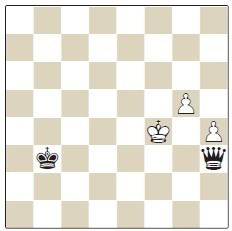
As always with juniors, you are both amazed at the things these young players can do and then surprised at the things they still haven’t mastered. The following two positions were particularly striking in that regard. A group of four or five children gathered around the table and would not accept the grandmaster’s wise advice that both were winning for White!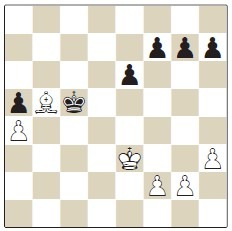
 In the first position, their reasoning was that since I had a light-squared bishop, they could put their pawns on dark squares and White couldn’t do anything. Something like this:
 And now the idea of ‘waiting Black out’ was one that they struggled with. The idea that with his extra piece, White has an unlimited number of waiting moves and that sooner or later Black will need to abandon his defensive structure took them some time to grasp. The misevaluation of the position with a queen against two pawns was based on the same misconception.
Watching the juniors’ games – both while commentating and later during the standard time limit event – I was struck by the thought that many of the juniors’ (already excellent) play could be improved still further by the application of some simple principles. But as a parent in another context remarked to me, teaching children simple things is one of the hardest challenges for a parent! (I was very proud though when the next day, one of the same little boys came to show me his game and proudly declared ‘I did a zugzwang!’)
And of course, there is the commentator’s trap of finding everything very obvious when you’re watching others play. I guess it’s too tempting to act as if merely seeing possibilities is enough.
In a practical game, spotting possibilities isn’t really the torture: the hardest part is choosing between the different options. I’m sure that if I were ever to start playing again, the most necessary training would be to re-activate that decision-making ability. The problem is: how do you train that? It’s essentially a skill that is forged in the heat of battle!
How about puzzle books, you may ask? Well, I’m glad you did, because that’s what I’ve been looking at this month! And not just looking – I’ve also been trying out lots of puzzles as well.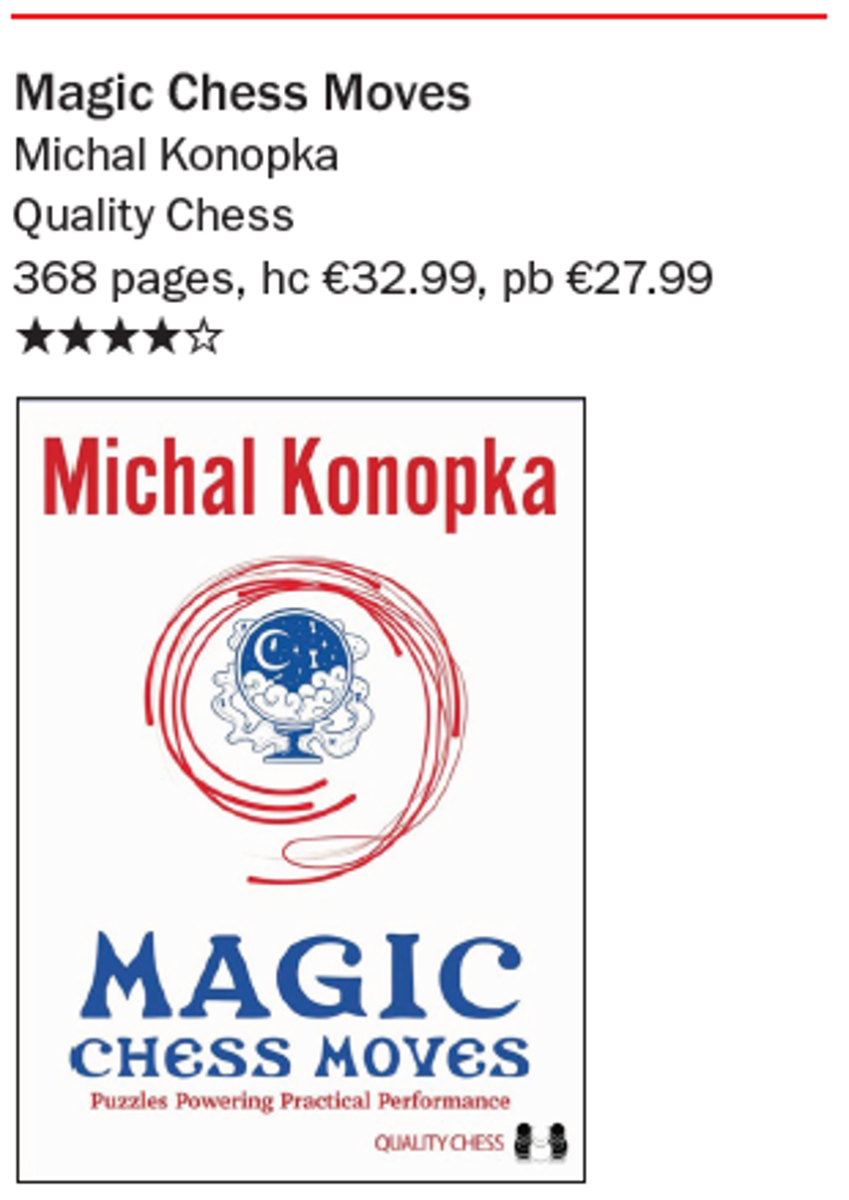 We start off with Michal Konopka’s Magic Chess Moves. The author’s name was unknown to me: he’s an IM from the Czech Republic who has coached some of the top Czech players, as well as being the captain of the Czech national team for some years. The introductory chapters are very interesting. Konopka describes how he selects puzzles for his students, demonstrating some puzzles he rejected, some puzzles he tweaked, and some (studies mostly) he shortened to make them better puzzle material. It’s clear this collection has been curated with great care, and I enjoyed greatly solving many of the 317 puzzles Konopka dishes up for us! The first 225 are given without comments. You simply get a diagram (six on a page) and an indication of who is to move, and you’re on your own! It’s up to you to figure out what each side is playing for and what the best move is. The last set of puzzles comes with some small hints or questions, such as ‘How should the game end?’, ‘Analyse 1...♘xf4’ or ‘Assess the move 1...♗xg2’.
For me, the book had the nice, unthreatening feel of a good old-fashioned puzzle book, only with better positions and an absence of mistakes!
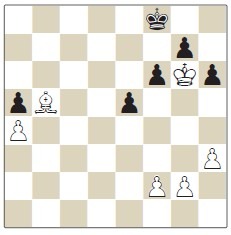
I don’t want to ruin your pleasure in solving any of these puzzles, so I will cite an example which didn’t make it into the final collection!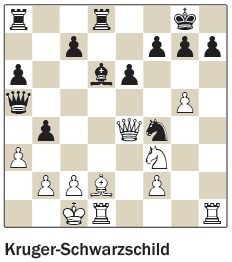 Konopka explains that he found this example in a book (the game isn’t in any database) and he was attracted by the spectacular winning line given. Can you guess what it was (putting aside any accurate refutations of the idea)?
1...bxa3 2.♗xa5 a2 3.♕a4 ♗a3!!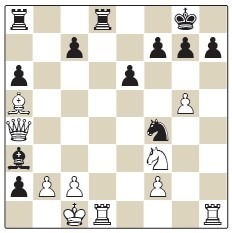 was the gorgeous idea, when the threat of ...a1♕ forces
4.♕xa3
which, however, allows
4...♘e2#
However... White has a defence! Can you spot it?
1...bxa3 2.♗xa5 a2
can be met by
3.♕xh7+ ♔f8 4.♔d2
Konopka suggests correcting the position in the following way: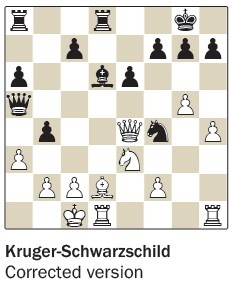 Now, after
1...bxa3 2.♗xa5 a2
3.♕xh7+ leads nowhere, of course, while 3.♔d2 allows the lovely 3...♗b4+.
Pretty neat and a good illustration of the effort Konopka has put into this collection!
A good effort, well worth some of your solving time! 4 stars!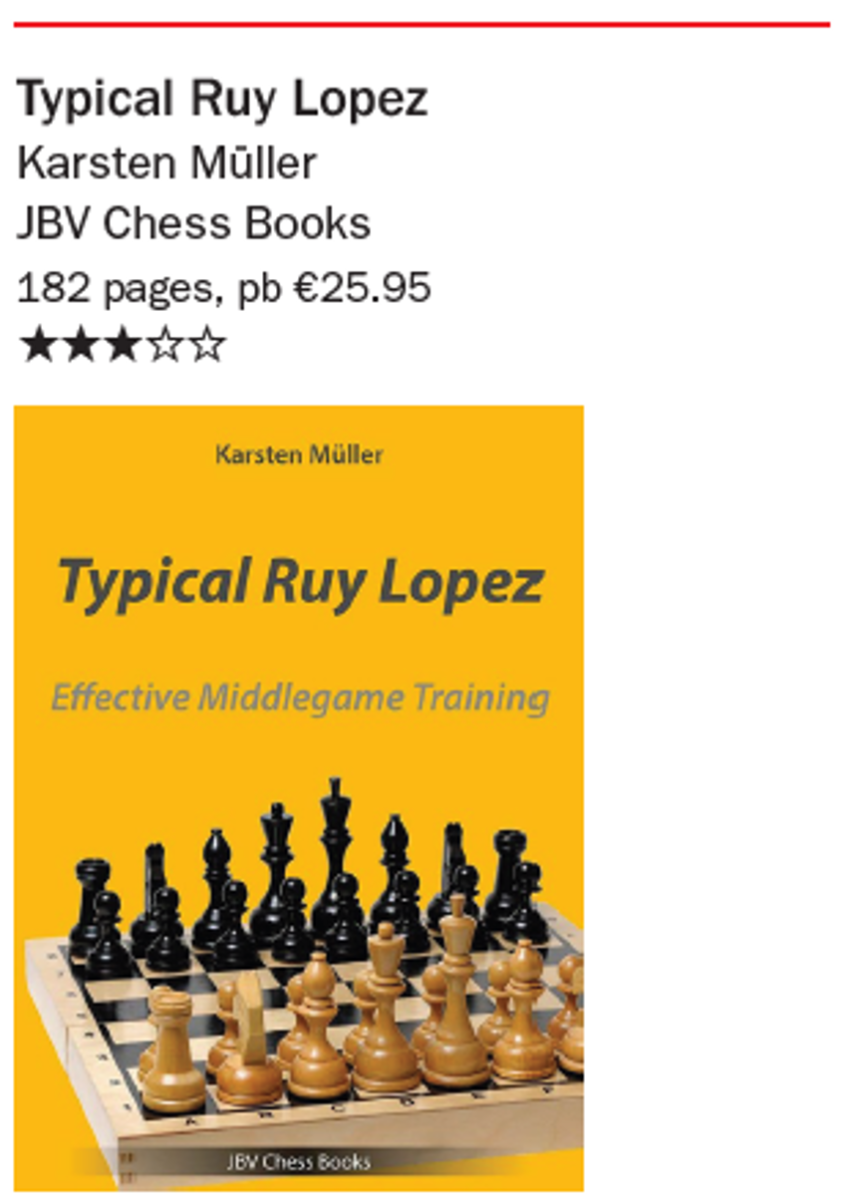 I’ve discussed Karsten Müller’s ongoing series of opening-themed middlegame training books before, but since I’m looking at puzzle books this month, it’s worth mentioning his latest effort: Typical Ruy Lopez.
The idea is very nice: you take a series of pawn structures from an opening and then present a series of middlegame exercises (102 puzzles in total) – both tactical and strategical – from those structures. It’s a pretty good way to build up experience in the pawn structures associated with a specific opening. In this book there are twelve pawn structures covered, arising from the various mutations of the Ruy Lopez centre.
Perhaps the only criticism of these books that I have – and it may just be a personal reaction – is that I sometimes find it a little hard to settle on the positions to study them. I think that happens because of the quite specific questions that Karsten asks in most positions (for example, ‘After which of the moves ♗b3 or ♗b1 would White end up at a disadvantage?’).
I suspect that this has the same effect on me as seeing the engine suggestion in a position – I feel pushed in a certain direction, and I lose the will to decide in my own mind first what I think. I suspect that I would really need to see the position first for a minute before the question is revealed to me!
I will share one of the positions which I really liked. The positions were grouped under the heading ‘Miscellaneous’ with the question, ‘Isn’t this a case for the classic bishop sacrifice on h7?’
David Gavrilescu
Lucian Miron
Satu Mare Foisor blitz 2020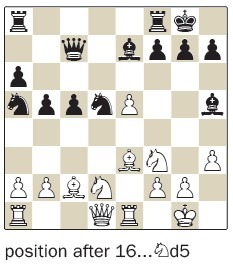 17.♗xh7+
This is indeed quite tempting in this unusual setting... and the refutation is equally unusual! See if you can spot it!
17...♔xh7 18.♘g5+
And now, instead of 18...♗xg5 19.♕xh5+ ♗h6 20.♗xh6 gxh6 21.♘e4 as in the game, which was very scary for Black (although he won in the end), Black should have braved the incredible move
18...♔h6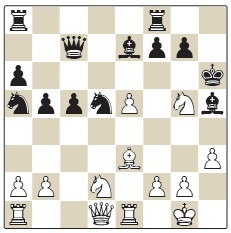 You often see ...♔h6 as a refutation to ♗xh7+ sacrifices, but not so often when there’s a discovered check in the air which can attack the black queen! However, the key point is 19.♘e6+ ♘xe3, destroying the checking piece and adding even a second attack on the white queen!
All in all, a nice book concept and definitely useful for any budding Lopez players (either colour) out there! 3 stars!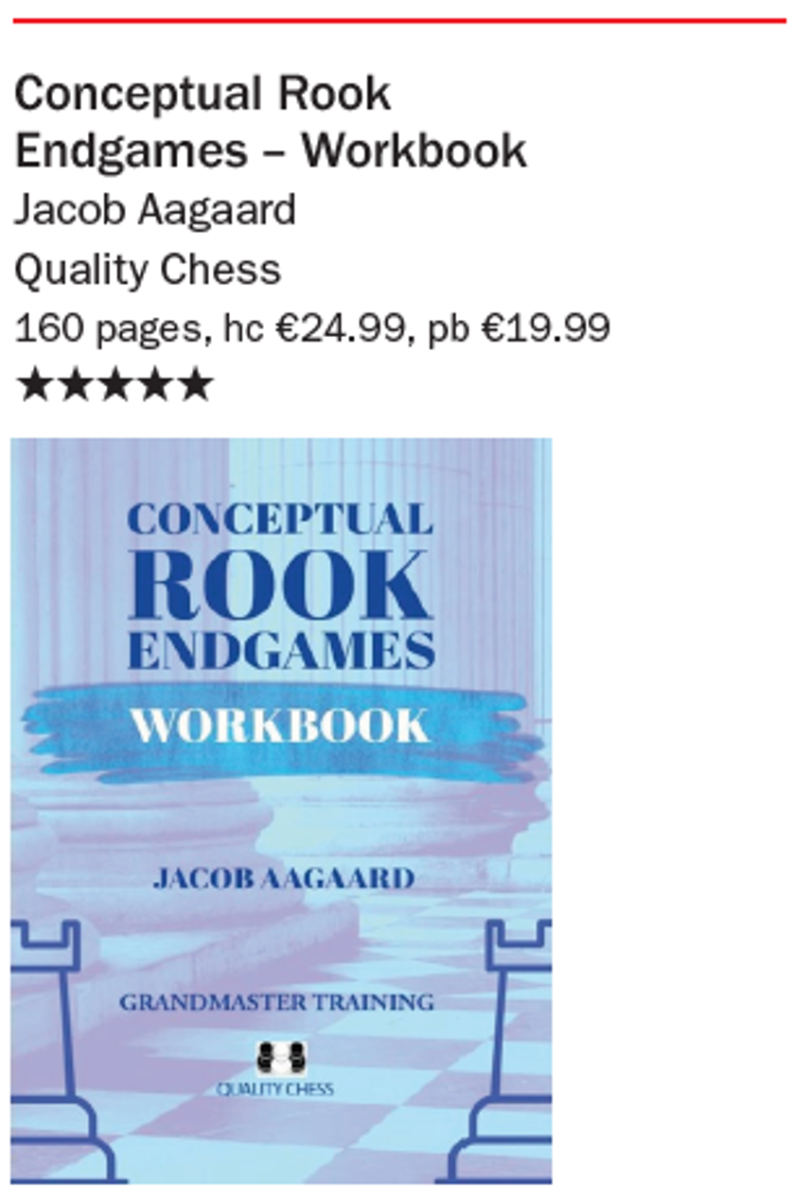 I’m not a golf player, but even on my social media feed, a clip entitled ‘This has to be the most misjudged putt in golf history’ has been doing the rounds (accidental pun). It features the unfortunate professional Connor Syme turning a difficult putt into an absolute nightmare, firing it past the hole at top speed into oblivion. While watching it, it struck me that a competitive sport tends to have one key element in which a professional is expected to demonstrate his class. Failing in this key discipline is more than poor: it’s almost a moral crime, something to feel ashamed about. In chess, I definitely think that the endgame is that element. Speaking for myself, I have lost a fair number of poor games during my career, but nothing matches the awful inadequacy and deep shame I’ve felt when throwing away a perfectly decent endgame with a sustained level of incompetence!
You tend to assume that your endgame play will improve naturally as you get older: after all, the more practice you get in endgames, the more comfortable you should get. However, I don’t think it works like that automatically. As you get older, you develop certain expectations: you feel you ought to know some endgames (I’m a classy player, right?), and if you don’t, then your instinct ought to point you in the right direction without any special thought. I guess it’s linked to that sense of shame again, but this time it also inhibits you from concentrating fully on the problem in front of you. Good endgame puzzles can be a powerful antidote to these poor habits, but they do require a certain amount of masochism to make them worthwhile. You start off by guessing at the solution using only your genius. After two or three times of selecting the obvious mistake in the position, you have two choices: give up with a convincing excuse or persevere and think harder!
In slight mitigation, I also think that engines have had a more profound influence on endgames than we realise. Endgames that seemed relatively simple and clear to me when I was young seem to have taken on multiple layers of complexity in the past ten years! Take a look at some of Stockfish’s freakish endgame wins (realised against the very highest level of defence) in the TCEC if you don’t believe me!
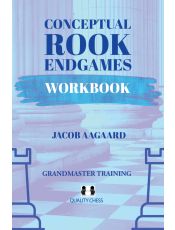
All this as an introduction to Conceptual Rook Endgames – Workbook by Jacob Aagaard, a set of 208 rook endgame puzzles ranging from the encouraging to the nightmare-inducing! It’s a set of puzzles that could have been included in Jacob’s earlier Conceptual Rook Endgames, but he wanted readers of that book to focus on the concepts (that book is structured around 25 rook endgame themes) rather than solving variations. These puzzles became a Chessable course instead, and this is the book version of that course. The book is just 160 pages, containing 208 exercises laid out with four or five puzzles per page and solutions on the reverse of the page. The idea of the layout is quite neat: it provides you with a ready-made chunk of work that you can verify after solving without seeing any of the solutions of future puzzles!
I solved a number of these, and I guess I’m going to keep on going in the next few months. I found it quite interesting to solve those four or five puzzles at a time and then spend a little time reflecting on the themes I’d come across. I don’t know how it is for you, but the biggest difficulty I have with endings is that I forget them very easily without daily practice. At best, I remain with only a faint glimmer of an idea, which again makes me think that I should know what to do, but which I can’t piece together in the little time I have left on the clock. Reflecting on the underlying general mechanisms helps somewhat. For example, take the very first position in the book:
Danyyil Dvirnyy
Piotr Lopusiewicz
Warsaw Wch Rapid 2021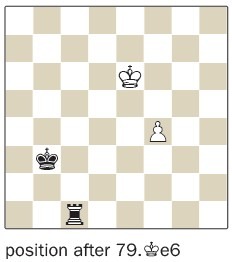 At the end of this rapid game, Black played naturally and rushed back his king towards the f-pawn. However, after
79...♔c4 80.f5 ♔c5 81.f6 ♖e1+ 82.♔d7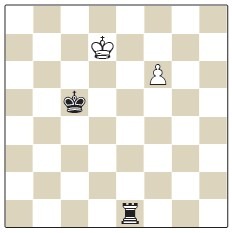 The white king made optimal use of its position, leaving the f-pawn free to advance while blocking the path of the black king back towards the f-pawn.
The game was drawn after:
82...♖f1 83.♔e7 ♔c6 84.f7 ♖e1+ 85.♔f6 ♔d7 86.f8♕ ♖f1+ 87.♔g7 ♖xf8 88.♔xf8
The correct idea is quite obvious, but it’s never obvious to spot the right idea at the right moment:
79...♖e1+
It’s maybe not immediately clear what you are doing with the check: after all, as we get stronger, we are conditioned towards not giving useless checks. However, it’s an example of something you notice a lot in all phases of the game when you play against engines: the disruptive move that makes your defensive or attacking structure just a little less attractive.
If the white king steps in front of the f-pawn, then queening will take one move more for White. Crucially, the black king’s path back to the f-pawn can no longer be impeded by the white king. All of a sudden, the black king seems to be sprinting back and reaching the target with ease!
80.♔f6 ♔c4 81.f5 ♔d5 82.♔g6 ♖f1 83.f6 ♔e6
A better try is:
80.♔d6
trying to maintain the white king’s dual role of supporting the f-pawn while keeping the black king at bay.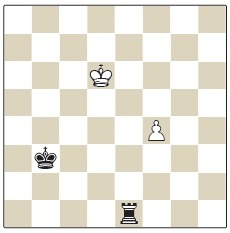 But now we can make the white king’s life more difficult by making its responsibility for the f-pawn weigh more heavily on his shoulders! And we do it with tempo!
80...♖f1 81.♔e5
The king has to step back, but now Black’s rook will be attacking the white pawn in perpetuity, and the white king will be tied to the e-file forever. So now the black king can jog back into play!
81...♔c4 82.f5 ♔c5 83.♔e6 ♔c6 84.f6
and now you can win in two ways:
84...♔c7 85.f7 ♔d8
Or:
84...♖e1+ 85.♔f5 ♔d7
I can’t say I particularly enjoy the process of solving difficult endgame puzzles, but I do appreciate the process of revisiting what you’ve actually solved! Adding that to the mix makes it much more bearable and I think much more likely to stick in your longterm memory.
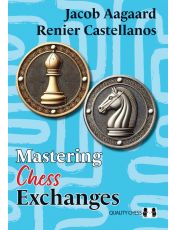
I like this book – I’m hesitating between 4 and 5 stars; 5 stars is a lot, maybe, for a 160-page book, but it achieves its goals excellently and could really be a very useful tool for building strength in an area that all of us find difficult! So we’ll go for 5 this time!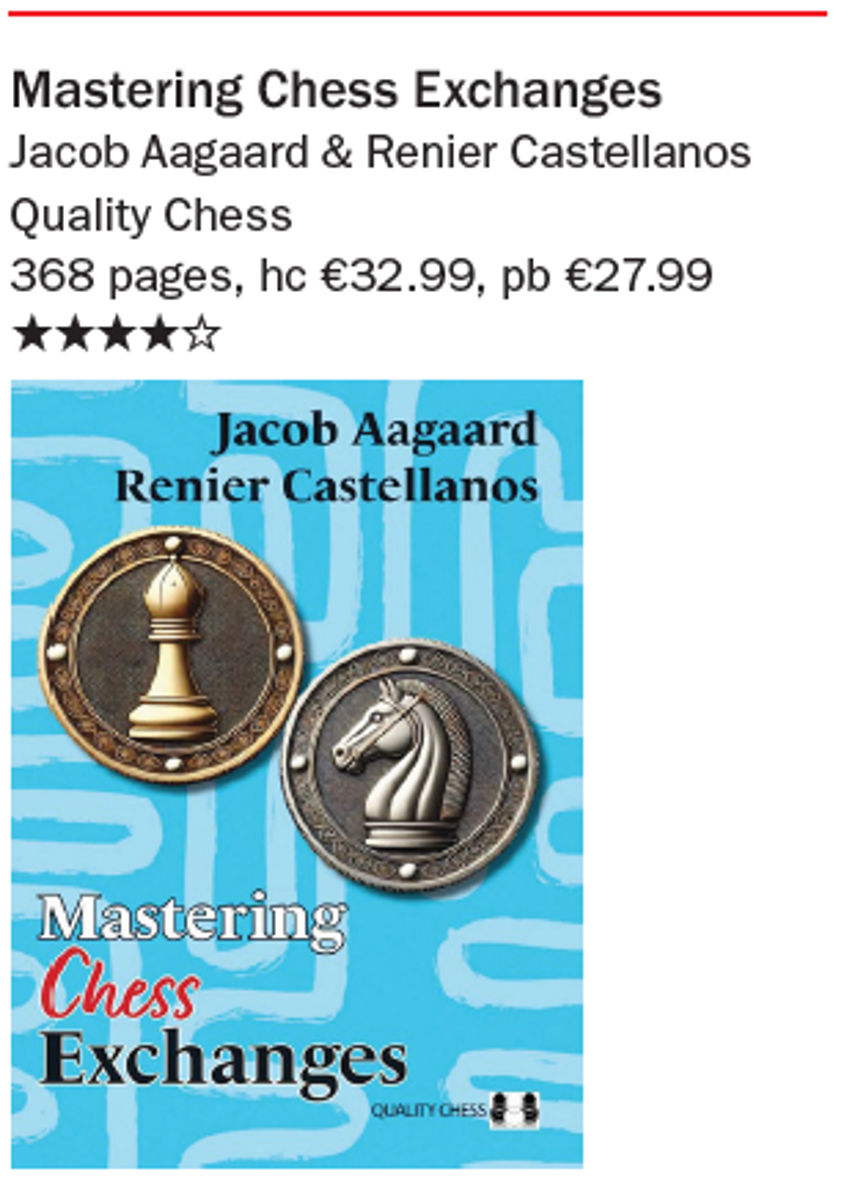 From endgames to exchanges now with the next book, also (co)-written by Jacob Aagaard. Mastering Chess Exchanges by Jacob Aagaard and Renier Castellanos (Quality Chess). After two chapters of introductory material on when – and when not – to exchange, we dive into five chapters of exercises ranging from ‘No Complexity or Tactics’ to ‘Bloody Difficult’(!)
So far, I’ve stayed in the safety of Chapter 3, but even here I’m struggling, to be honest! It’s possibly due to at least two things:
– Exchanges are really difficult to judge
– I don’t like exchanges!
I think I’m also suffering a little from what I described with Karsten’s book: the questions asked are quite specific, which gave me the feeling that my mind was being made up for me before I had properly studied the position. And sometimes, I resisted!
For example, take this position:
Mahammad Muradli
Adhiban Baskaran
Sharjah Masters 2022
Queen’s Gambit Declined
1.d4 e6 2.c4 ♘f6 3.♘f3 d5 4.♘c3 ♗b4 5.♗g5 h6 6.♗xf6 ♕xf6 7.♕a4+ ♘c6 8.e3 0-0 9.♖c1 ♖d8 10.♕b3 a5 11.cxd5 exd5 12.a3 a4 13.♕d1 ♗xc3+ 14.♖xc3 ♕g6 15.h3 ♗d7 16.♗d3 ♕d6 17.0-0 ♘a5 18.♘e5 ♗e8 19.♕c2 ♘c6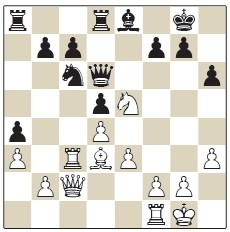 The question here is: ‘Should White A) exchange knights with 20.♘xc6 or B) retreat the knight?’
My (rather strong) reaction was,
‘Well, I am never going to play ♘xc6. The move I’m starting with is 20.f4 and I’ll only look at anything else if I can’t make it work!’ (my engines tell me it’s not the strongest move, however, although it maintains a white advantage) I mention this because I did have that type of reaction a number of times when considering the exercises, and that made it, on occasions, a bit harder to get through. It may just be my glitchy chess evaluation playing tricks on me, however: I can imagine that someone like Mickey might have a totally different (saner) reaction to many of these positions!
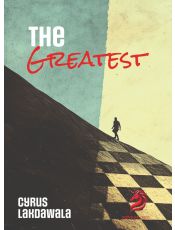
All-in-all, it’s another very good book from Quality Chess dealing with a subject that is extremely hard to appreciate properly. Possibly due to stylistic reasons, I’m struggling to be as enthusiastic about this one as about the Conceptual Rook Endgames – Workbook, so we’ll stay on 4 stars for now, but it’s one I will try to stick with as well, so who knows, I may have an update on my progress at a later stage!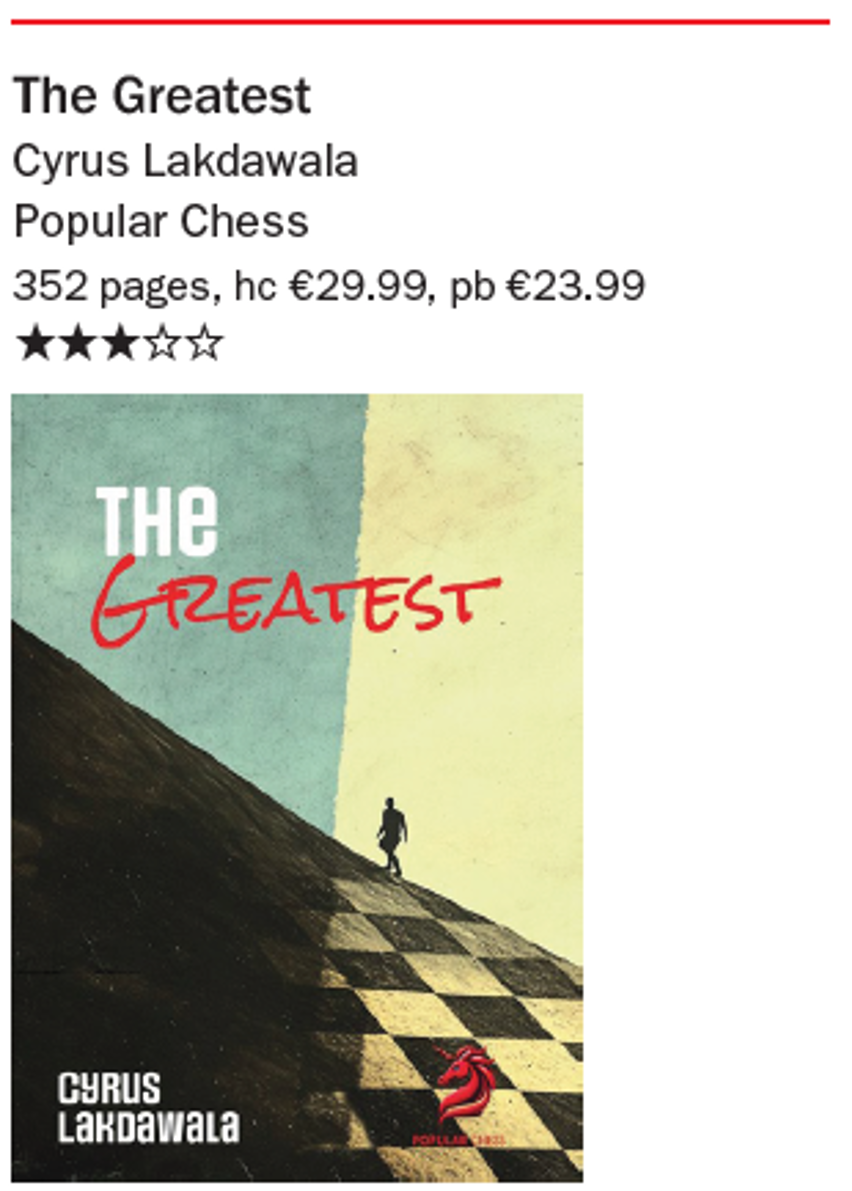 And to round off with something different, we have The Greatest by Cyrus Lakdawala, which is the author’s brave attempt to tackle the question of who the greatest player of all time is. To put it mildly, this is not an uncontroversial subject, so I’d be intrigued to know the feedback he’s received since publication!
 While reading it, the phrase ‘best read with clenched teeth’ came into my head and wouldn’t leave! For a player of my generation, it’s simply impossible to be confronted with any series of lists and judgements on this topic without erupting in rage and shouting out such phrases as ‘and what about Janowski?’ However, forgetting my age, it was a pleasant and entertaining read, and there was a nice blend of little-known, well-known, and forgotten games to keep you entertained! 3 stars! ■
Related Posts
Related Products
As low as
€27.99
As low as
€19.99
As low as
€23.99
As low as
€27.99
1 Comment
Chris
on
Feb 04, 2026 17:16
How is the second position winning for White? Looks winning for Black to me with either side to move or with either board orientation.
Submit your comment